All example booksStart their letters

This is a sample book. The questions are the ones we really send — Joan and this family are fictional, written by us to show what a book becomes.

Joan

Joan's letters

Stories from Joan,
in their own words.

9 stories saved so far

Chapter

Childhood

7 September 2025

What games did you play as a child?

Whatever the street was playing that week. Games came round like weather — a fortnight of hopscotch, then suddenly everybody had a whip and top, then skipping, with the big rope stretched right across the road, and you could do that then, because there were no cars. Not one car on our street until Mr Bassett's Austin in about 1952, and we treated it like the circus had come.

We chalked hopscotch squares on the flagstones and played out till the streetlights came on, which was the only clock we ever needed. Two-ball against the coal-shed wall, with rhymes to go with it that I could still recite now. British Bulldog until somebody went home crying — there was always one, and quite often it was your great-uncle Ronnie.

Nothing cost anything, that's what I notice looking back. A rope, a bit of chalk, a tennis ball gone bald. We were turned out after breakfast like cats and expected back when we were hungry, and the whole street was ours.
14 September 2025

What was your school like?

Two rooms. Little ones in one, big ones in the other, and a coke stove in the corner with a fireguard round it that the teacher dried wet coats on, so all winter the room smelled of coke and steaming wool. I can smell it now, doing this.

Miss Askew had the little ones. She seemed a hundred years old to us and was probably forty. Slates first, then pencils when you were trusted, then the dip pens with the inkwells set into the desks, and I was ink monitor for a term, which was high office. You mixed the ink from powder, and the smell of that powder is another one that's never left.

Milk came in third-of-a-pint bottles, and in winter it froze and pushed the foil caps up on little columns of ice, and they stood the crate by the stove so we drank it warm on one side and frozen on the other. I was happy there. I cried when I moved up to the big school in town, and Miss Askew told me that clever girls don't cry, they get on. So I got on.

21 September 2025

What was your bedroom like when you were young?

Shared with my two sisters, and for most of those years, shared meaning one bed, me in the middle because I was youngest and it was the warm spot — the only privilege of being youngest, and I took it.

Candlewick bedspread, pink, gone bald in patches where we picked at it, which we were told not to and did. A washstand with a jug and bowl, because the tap was downstairs and the loo was outside, down the yard, and on winter nights there was a chamber pot under the bed and no shame about it, that was just houses then. Ice on the inside of the window by morning — proper ferns and feathers of it, and Doreen used to say the frost fairy had been, and I believed her longer than I'll admit.

The three of us top to toe, hot water bottle rotated on a strict system, and Doreen telling stories in the dark until Margaret-next-door's dog barked and set the whole street's dogs off. I've slept in comfortable rooms for sixty years since. I remember that cold one best.

28 September 2025

What was your favourite holiday or day out as a child?

The charabanc to Scarborough, once a summer, organised by the chapel. Everybody's mother in her good coat regardless of the weather, and the weather wanted watching.

The bus itself was half the day out. Singing on the way — the same songs every year, in the same order, as if there was a printed programme. Then that game where the first one to see the sea got a penny, and the sea always showed itself the same way, a grey line between two hills, and the whole bus shouted anyway.

Sixpence to spend, and I budgeted it like a chancellor. Penny for the slot machines, penny for a go on the donkeys, tuppence for an ice cream, and tuppence kept back for emergencies, by which I meant more slot machines. Sandwiches on the sand with actual sand in them, my father asleep with a handkerchief on his head, and the long sunburnt sleep on the bus home. If you'd told me then about aeroplanes and Spain, I'd not have swapped.

Chapter

Family

5 October 2025

What did you call your grandparents?

Nana and Pop on my mother's side. Nana was soft as butter and smelled of lavender water and let us dip bread in her tea, which my mother called disgusting and my Nana called nourishment.

Pop kept racing pigeons, and going up his garden to the loft was the treat of any visit. He'd let me hold one if I stood still, and I can feel it now — that quick heartbeat in your two hands, and Pop saying "she'll not hurt you and you'll not hurt her." He talked to those birds more tenderly than to any human, my mother said, and it wasn't a complaint, quite.

On my father's side there was only Grandma Ackroyd, widowed young, chapel twice on Sundays, and frightened of nothing on this earth. We were taken to see her monthly, scrubbed and warned in the same breath. She'd inspect our fingernails, pronounce on them, and then — this is the part nobody warned you about — produce humbugs from a tin and become, for one hour, quietly funny. I was fifteen before I worked out she'd been playing a part the whole time, and that the humbugs were the truth of her.

12 October 2025

What were family dinners like when you were growing up?

You have to remember the ration books ran until I was thirteen. Nineteen fifty-four, sweets came off ration, and I remember the actual day, because Mr Siddall at the corner shop had a queue out the door and my mother said the whole street had gone silly. It had. I was in the queue.

So dinners were plain and nobody said otherwise. My mother could make a small amount of meat go round five people like a conjuring trick — everything padded with bread, potatoes, suet. Bread and dripping when things were tight, with salt, and I'm sorry to report to my doctor that it was delicious. Father served first and got the best of it, not because anyone thought him more important, but because his wage was the house, and even we children understood the arithmetic.

You ate what was put in front of you, and the sentence "eyes bigger than your belly" was the law of the land. But Sunday tea, after chapel — tinned salmon if it had been a good week, and my mother's curd tart — that was plenty. I've eaten in restaurants your grandfather grumbled at the price of, and nothing's ever beaten that curd tart. I'd give a week of my life for one more slice of it, cut by her hand.

Chapter

Senses & Places

19 October 2025

What smells remind you of home?

Coal fire, first and forever. Every house on the street burned coal, and coming home on a winter afternoon the whole village smelled of it, and to this day if I pass a real coal fire — rare now — I'm eight years old before I can stop myself.

Then Monday. Monday was washday and it had its own weather: steam, green soap, the copper going in the corner and the windows running with it. Carbolic soap, which took skin off but got shirts white. My mother with her sleeves rolled and her hair curling in the steam, feeding sheets through the mangle and me catching them the other side, being warned about my fingers every single week for ten years.

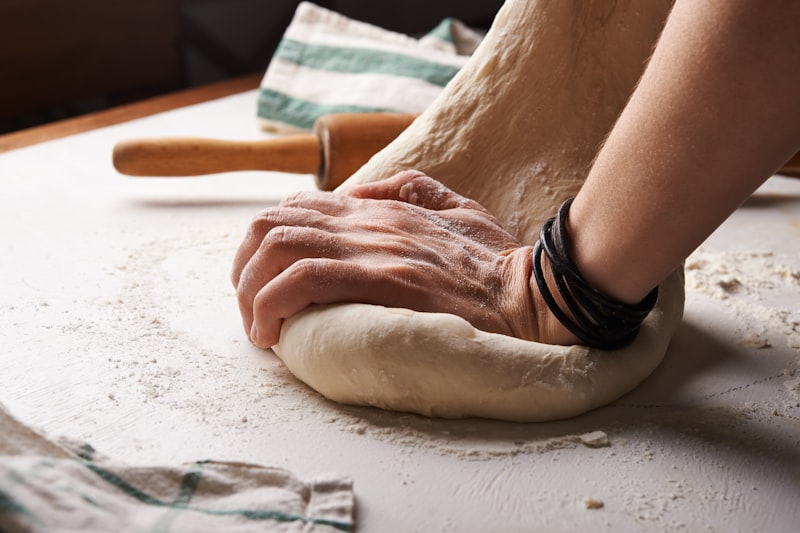
And bread. My mother baked on Thursdays, and if you timed your entrance right you got the first slice off a warm loaf with margarine melting into the holes. I've bought every fancy loaf that's been invented since, and I'm still just chasing Thursday.

Kneading bread dough by hand

26 October 2025

What sounds do you associate with your childhood?

The rag-and-bone man's call, streets away and getting nearer — nobody could ever agree what the words actually were, if they were words at all, but every child in England knew the tune of it. The milk cart at dawn, bottles ringing in their crate, and the horse before the electric float came in, which was a loss to us children and to my mother's roses both.

The wireless, always. Listen with Mother at quarter to two when I was small — "are you sitting comfortably?" — and I was, on the pegged rug, right up against the set. Later, the whole family arranged round it for the Light Programme the way families arrange round televisions now, except you looked at the fire while you listened, and the fire was better than most of what's been on television since.

And the churchbells on Sunday morning, and everybody's doors going, and somebody's mother — often mine — calling somebody — often me — in from the street in that long two-note call they all used. Jo-oan. You could pick your own mother's call out of a dozen, blindfolded. I'd know it still.

Chapter

Hopes & Dreams

2 November 2025

What do you want your grandchildren to know about you?

That I was a dancer. You've only known me with my hips gone, but I want it on the record: your grandmother won medals for ballroom, and when I was seventeen I danced every dance at the Co-op Hall and walked home barefoot carrying my shoes because my feet were ruined and it had been worth it. There's a photograph somewhere of me in a dress Doreen and I made from a pattern, and I looked, if I say so myself, a picture.

That the childhood in these letters was a happy one, even though it will sound poor to you. It was poor. Everybody's was, so nobody minded — you can't miss what no one on the street has got. What we had instead was each other at very close range, and I've come to think that was the luxury, though I'd have taken an indoor loo as well, given the choice.

And that I think of you all far more than I ring you. That's the generation I am — we didn't ring long-distance unless somebody had died, and the habit stuck. But writing these down, I find you're who I'm writing them for. Somebody should know the sound the milk cart made. Now you do.

Their stories could read like this.

One question a week, by email. They just reply. The book builds itself quietly.